

Epoxy bonds dormant structural cracks; polyurethane seals leaking ones. How engineers choose, how injection works, and when it isn't the answer.
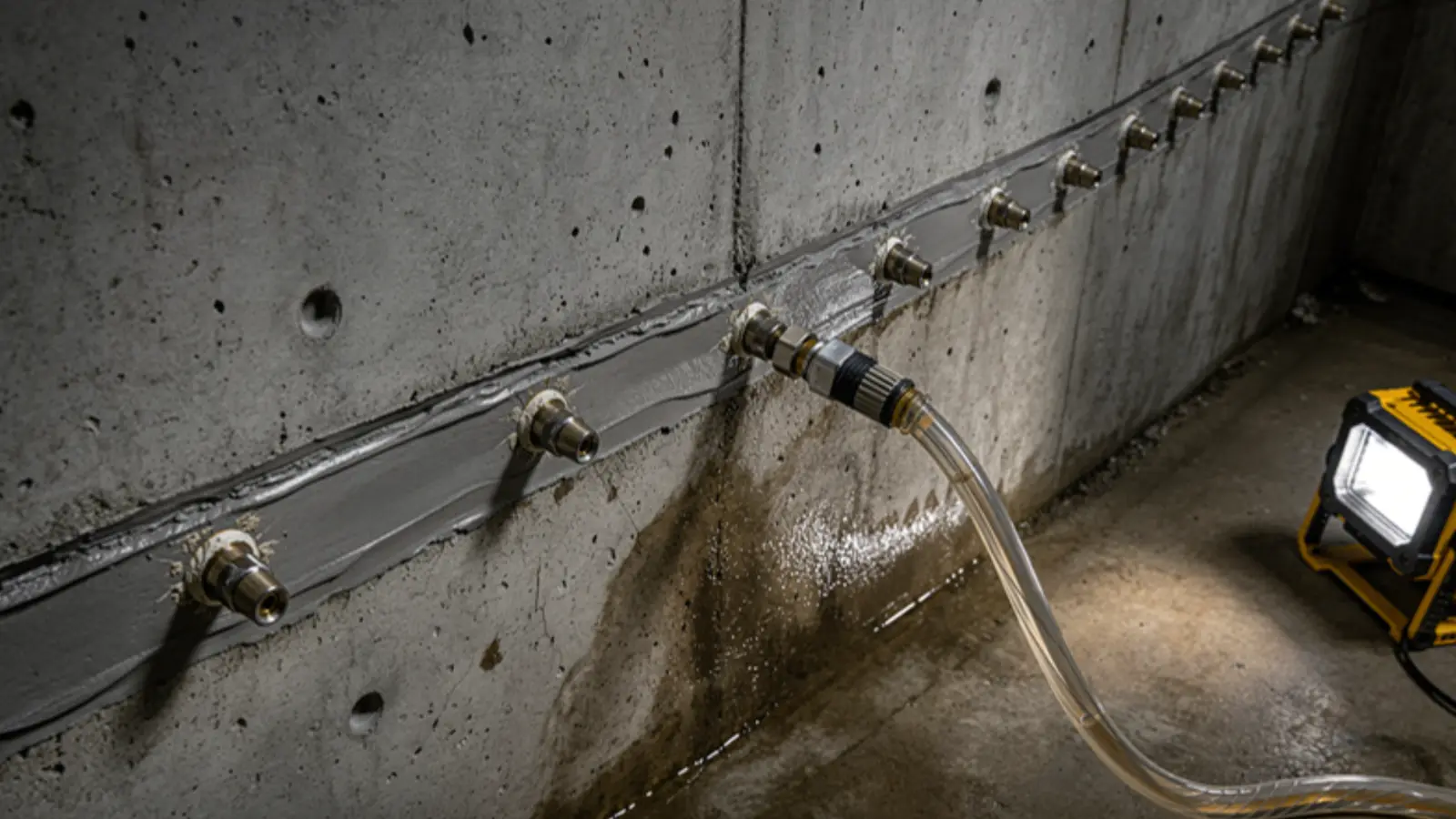
Use epoxy when a dormant crack needs its structural strength restored: it bonds the two faces back together. Use polyurethane when a crack is leaking water or may still move: it seals and stays flexible but adds no strength. The engineer decides which applies, based on what caused the crack and whether it's still moving.
Crack injection gets talked about as one service, but epoxy and polyurethane do different things.
Low-viscosity structural epoxy is injected under pressure to fill the crack and bond the concrete back together. Once cured, it is typically stronger than the surrounding concrete. It's the right tool when the engineer wants the element to act as one piece again, for example cracked beams, slabs, columns or walls where the cause has been dealt with and the crack has stopped moving. Epoxy needs a reasonably dry crack to bond well, and it is rigid: if the crack moves again, it will crack again, usually next to the repair.
Polyurethane resins react with water. Some foam and expand, others cure to a flexible gel or elastomer. They're used to stop active leaks through basement walls, lift pits, retaining walls, slabs and joints. Because they stay flexible, they tolerate some ongoing movement. They don't restore structural strength, so a polyurethane injection on a structural crack is a waterproofing fix, not a structural repair.
Some cracks need both. A structural crack that is also leaking may be stopped with polyurethane first, then bonded with epoxy once it is dry, if the engineer specifies it.
A dormant crack has stopped moving. It formed from a one-off cause, such as early shrinkage, a past overload or settlement that has finished. A live crack is still opening and closing, because of thermal cycling, ongoing settlement, vibration or a structural problem that hasn't been fixed.
Rigid epoxy in a live crack is a short-term fix. The movement just finds the next weakest line. So before anything is injected, someone needs to know whether the crack is still moving. Engineers typically find out by:
If the crack is caused by corroding reinforcement, injection isn't the fix at all. That's a concrete cancer repair, which is covered below.
On structural work, the engineer's specification normally covers:
We inject to that specification. We don't design or certify structural work, and we don't substitute materials without the engineer's sign-off.
Good crack injection starts and ends with a map. Before work starts, each crack is identified, numbered and recorded with its location, length and width, with photos. During the project, the record shows the resin used, batch numbers, the ports injected and anything unusual, such as a crack that took far more resin than expected, which can point to a void behind it.
That map becomes your repair register for the injection scope. It's what the engineer uses to release hold points, what you use to measure quantities, and what the next person needs if a crack returns. We hand it back with the project records.
If the crack was dormant and the right resin was used, epoxy injection is a permanent bond. If the crack is still moving, a rigid repair can re-crack nearby. That's why the live-or-dormant question comes first.
Yes. Water-reactive polyurethane is designed for exactly that. Just be clear it's a seal, not a structural repair.
The number and total length of cracks, element thickness, access, the resin specified, whether cores or testing are required, and working hours. Send the crack map or engineer's report and we'll price it to that scope.
Yes. Injection is relatively quiet and contained, so it's staged around your program and the site's permitted hours.
Send the engineer's report, crack map or photos to quotes@aussieconcreterepair.com.au or call 0410 515 509. We call back within the hour and send an itemised quote within 7 days. NSW licence 360636C, ACRA member. More on the service: concrete crack injection.
Send photos, the engineer's spec or drawings, or just the symptoms — whatever you've got. The crew reads it and calls you back. No call centre, no obligation.