

How to spot concrete cancer, why patch-overs fail, and the engineer-led breakout, steel treatment and reinstatement sequence. A guide for Sydney builders.
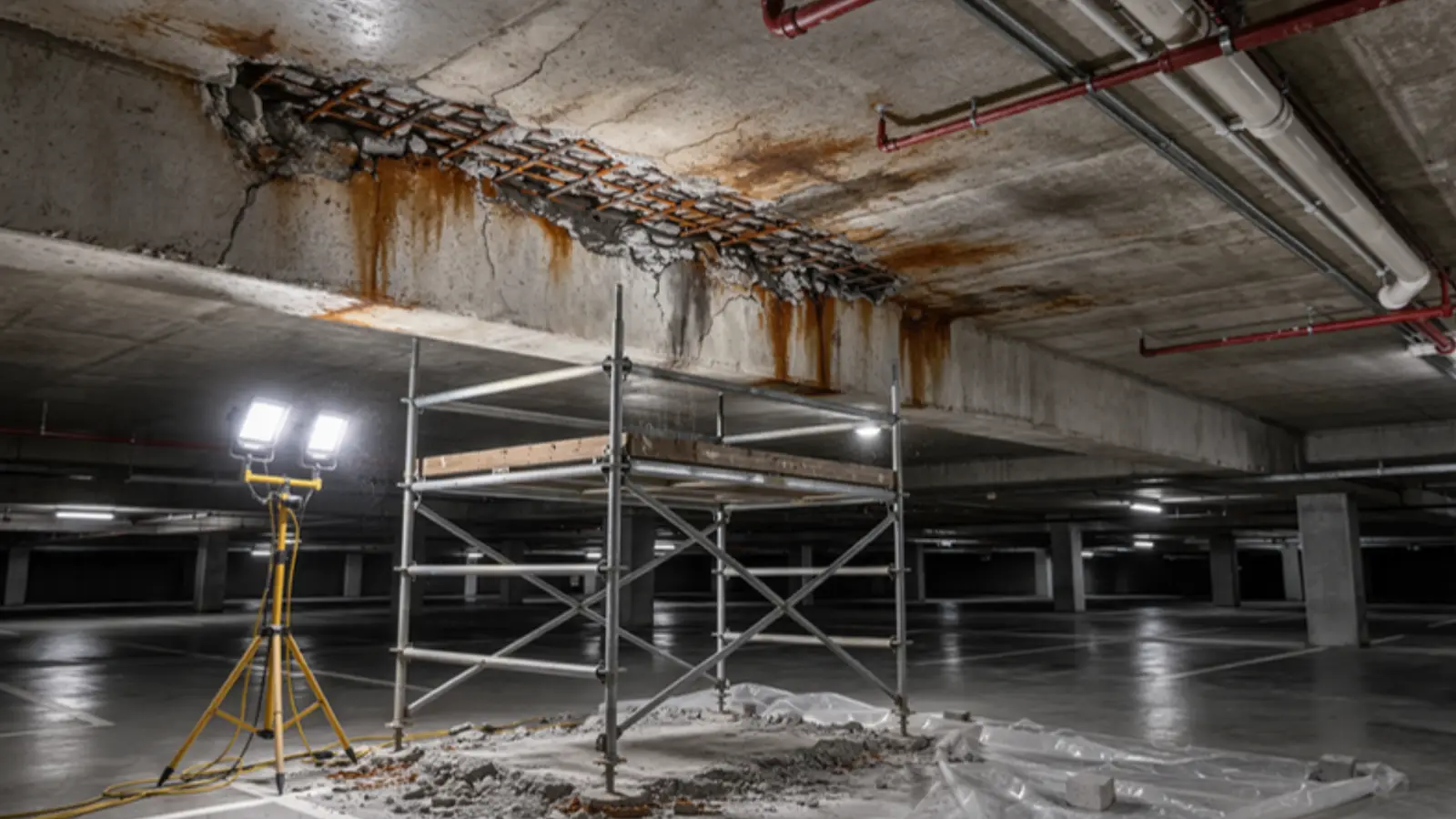
Concrete cancer is corroding reinforcement: the rust expands, cracks the cover and pushes it off as spalling. On a live site the fix is not a patch. The engineer scopes it, damaged concrete is broken out behind the bar, the steel is cleaned and treated, and the section is reinstated to spec, with every stage recorded.
Most builders meet concrete cancer in a refurbishment, an extension over an existing structure, or a car park or podium that has been exposed to moisture and salt air for decades. The signs are usually visible well before anything falls off:
Treat drummy and spalled areas over walkways, driveways or occupied areas as a safety issue first. Make them safe and barricade them before anyone talks about scope.
The most common thing we break out on Sydney projects is somebody else's old patch. A render or mortar skim over a spall looks fine on handover day, but it leaves the cause behind. Corrosion continues on the steel under and around the patch, the rust expands again, and the patch lets go, usually taking more good concrete with it.
Patch-overs fail for three reasons. The corroded steel was never exposed all the way round, so it was never properly cleaned or treated. The repair didn't go back far enough to reach sound concrete. And the repair material wasn't compatible with the substrate, so it shrank, cracked or debonded. A durable repair deals with all three.
On any structural element, the scope should come from a structural or remedial engineer, not from the repair contractor. The engineer's report or specification typically sets:
If you only have a condition report without a repair specification, get one before you price the package. Without it, every quote is based on a different assumption, and the cheapest one is usually the one that left the most out.
Repair areas are marked out to clean, square edges and saw-cut at the perimeter so the repair doesn't feather out to nothing. Damaged concrete is broken out with light breakers, going behind the corroded reinforcement so the bar is free all the way round. The breakout continues along the bar until clean, uncorroded steel is found. This is the stage where quantities grow, which is why the repair register matters (see below).
Exposed reinforcement is cleaned back to bright steel, typically by abrasive blasting or wire brushing, to the standard in the specification. The engineer inspects bars with significant section loss and decides whether to add or replace steel. The cleaned bar then receives the specified treatment, such as a protective primer, before reinstatement.
The substrate is cleaned and prepared as the system requires, then the section is rebuilt. Shallow and smaller repairs are usually hand-applied with a repair mortar in layers. Deeper or larger sections, or anything that needs new reinforcement, may need formwork and a repair pour. We cover that decision in form, reo and pour repairs. The repair is cured as specified, and a protective coating may follow.
The hold points are what protect you at handover. Typical points on a concrete cancer scope are: after breakout, before steel treatment (so the engineer can see the extent and the bar condition), after steel treatment and before reinstatement, and at completion.
The repair register is the record that ties it together: every repair location, its dimensions, photos at breakout and completion, any extra steel added, materials used and the date each hold point was released. On a remeasure project, it is also the basis for quantities and variations. We keep one on every project and hand it back with the records, because it's what your superintendent and the engineer will ask for.
Pricing is driven by the number and size of repairs, access (scaffold, EWP or rope), how much steel needs treating or replacing, the hold point regime and working hours. Send the engineer's report and drawings and we'll price it to that scope.
You can make it safe now, by removing loose concrete and barricading the area. But a cosmetic patch over corroding steel generally has to be broken out again later, so it adds cost rather than saving it. If the engineer approves a temporary measure, we'll do exactly that and record it.
The engineer's specification sets the rule, and the engineer inspects at the breakout hold point. We break out to that rule and record what we find. If the steel is worse than expected, we stop and get direction rather than guessing.
No. We don't design or certify structural work. We build to the engineer's specification, flag buildability issues early and give you the records to close it out.
Yes. Breakout is staged to the hours the site allows, which helps when it has to happen outside trading or occupancy hours.
Send the engineer's report, drawings and photos to quotes@aussieconcreterepair.com.au or call 0410 515 509. We call back within the hour and send an itemised quote within 7 days. NSW licence 360636C, ACRA member. More on the service: concrete cancer and spalling repair. If cracking is part of the picture, see crack injection, and for protection after repair, protective coatings.
Send photos, the engineer's spec or drawings, or just the symptoms — whatever you've got. The crew reads it and calls you back. No call centre, no obligation.