

How head contractors should scope a commercial concrete repair package: what to send, how to measure it, hold points, program and the records that close it out.
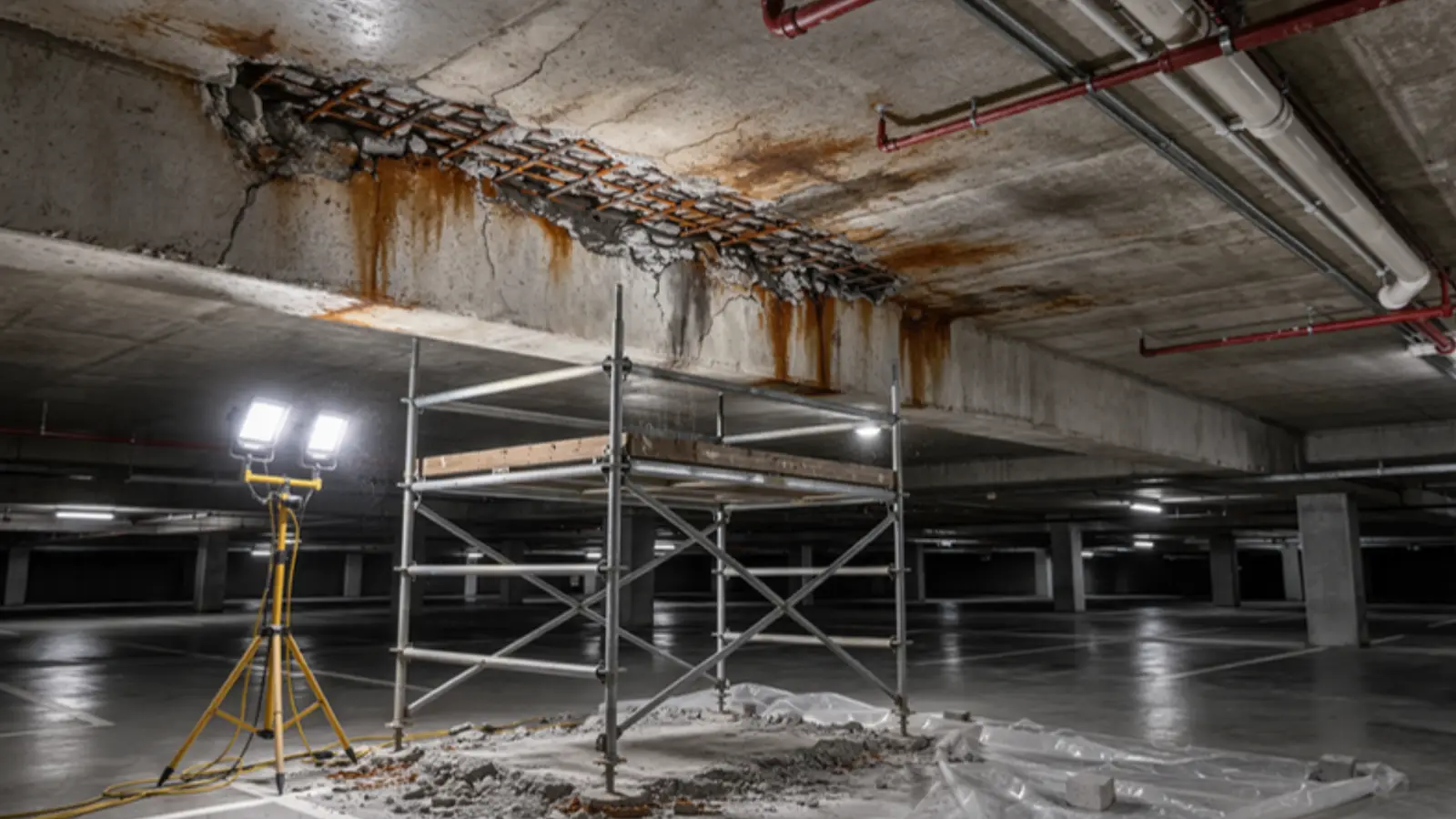
Short answer: scope commercial concrete repair from the engineer's specification, price it on measured rates (per litre, per lineal metre, per m²) rather than a lump sum, set the hold points up front, and require a repair register at handover. That keeps variations evidence-based and lets you compare subcontract quotes on the same scope.
Get the engineer's report, repair specification and marked-up drawings before you tender the package. Without them, each subcontractor prices a different assumption and the cheapest quote is usually the one that left the most out.
Measured items make quantity growth after breakout a rate times a measured quantity, not an argument.
Typical hold points: after breakout, after steel treatment, before pour or reinstatement, after CFRP surface preparation, and at completion. Program the engineer visits and group locations so one inspection releases several.
Access (scaffold, EWP, rope) often costs as much as the repairs on small scopes. Breakout and cutting are noisy and dusty; stage them around trading hours, residents and other trades. Scan before cutting or demolition for reo, post-tensioning and services.
Ask for a repair register: every location numbered with dimensions, depth, steel condition, before-and-after photos and materials, plus product data sheets and hold-point sign-offs. It's what your superintendent, certifier and client will ask for.
Concrete cancer repair, crack injection, CFRP, joint sealing, coatings, floor levelling and demolition often sit in the same package. One concrete subcontractor across all of them means one program, one register and one point of contact.
Send the specification, drawings and program to quotes@aussieconcreterepair.com.au or call 0410 515 509. We call back within the hour, quote itemised within 7 days, and typically start about 2 weeks after award. NSW licence 360636C, ACRA member.
Send photos, the engineer's spec or drawings, or just the symptoms — whatever you've got. The crew reads it and calls you back. No call centre, no obligation.