
Your concrete scope, built to the engineer’s spec.
We’re the concrete subcontractor remedial builders bring in for the concrete scope — cancer and spalling repairs, form, reo and pour, crack injection, carbon fibre, joint sealing, coatings, levelling and demolition. Built to the specified system, hold points called, records handed back so you can close out with the engineer.
No obligation. We call back within the hour.
Get a quote



We build the concrete scope to spec — and prove it.
The concrete scope is where a remedial project usually goes sideways: a sub substitutes a repair mortar, skips a hold point, or can’t produce the records the engineer asks for at close-out. The engineer comes back to you, not them.
We work the opposite way: we build to the specified system, call hold points and wait for the engineer’s sign-off, and hand back the records you need to close out. You stay the head contractor; we make the concrete scope the easy part.
Get a quote →We build to the specified system
The repair mortar, injection resin, sealant or coating the engineer nominated — built as specified. No substitutions without written sign-off.
We call hold points and wait
Inspections booked ahead through you, and we don’t proceed past a hold point until it’s signed off — so nothing gets covered up unchecked.
We hand back the records
Dated photos, quantities and inspection sign-offs by area — ready for your close-out pack, not reconstructed after the fact.
We scan before we cut
Slabs and walls are scanned before cutting or breaking out — so a tendon or a live service never becomes your problem.
Where a concrete sub can cost you the project — and how we de-risk it.
On a remedial project the concrete scope touches your program, your engineer and your margin at four points — pricing, hold points, delivery and close-out. Here’s the trap at each, and how we’re set up so it doesn’t land on you.
Priced to the spec.
A sub prices loose, then claims variations once the concrete is opened up — and you wear it with your client.
We price the scope to the spec and the quantities, itemised, with assumptions stated up front.
Verifying the work.
A sub closes up a repair before the engineer has inspected — and you’re the one asked to open it back up.
We book hold points ahead through you and wait for the engineer’s sign-off.
Turning up on program.
The concrete crew is late or short-handed, and every trade behind it stops.
We call back within the hour, quote within 7 days and typically start about 2 weeks after award.
Records you can hand over.
Thin or missing records hold up practical completion and your final claim.
Dated photos, quantities and sign-offs by area at handover.
Pick the wrong concrete sub and the call-back lands on you.
As head contractor, your concrete sub’s habits become your exposure. The wrong pick doesn’t just risk the repair — it risks your program, your margin and your standing with the engineer and the client.
Substitutions become your defect
A sub who swaps a repair system or improvises a detail creates a defect the engineer rejects — and it sits under your contract, not theirs.
Covered-up work nobody verified
Once a repair is closed up without a hold point, the engineer can’t sign it off. A crew that waits for verification protects your close-out.
Missing records hold up your claim
Practical completion is only as clean as the records behind it. Without them, close-out drags — and so does payment.
The concrete scope, from one crew.
Repair, form-and-pour, crack injection, joints and coatings under one subcontract — built to the engineer's spec, with hold points recorded, instead of three concrete subbies on your program.
Built to the spec — verified, not improvised.
For a remedial contractor, the question isn’t just what the concrete sub costs — it’s whether they’ll build the scope as specified, on program, and leave you the records. Here’s how we work so the answer is yes.
We build the specified system
The repair method, mortar, resin, sealant or coating the engineer nominated — built as specified. No “equivalent” products and no on-site reinterpretation without written sign-off.
We call hold points and wait
Every inspection is booked ahead through you, and work does not proceed past a hold point until it’s signed off — so nothing is covered up before the engineer has seen it.
We hand back the records
Dated photos, quantities and inspection sign-offs by area — kept as we go, ready for your close-out pack.
We scan before we cut
Slabs and walls are scanned before cutting or break-out, so tendons, reinforcement and services are located before the saw goes in.
Built to spec. Hold points verified. Recorded.
Concrete packages we've taken on as a subcontract: built to the spec, tidy on occupied sites, with the records handed back for your close-out.
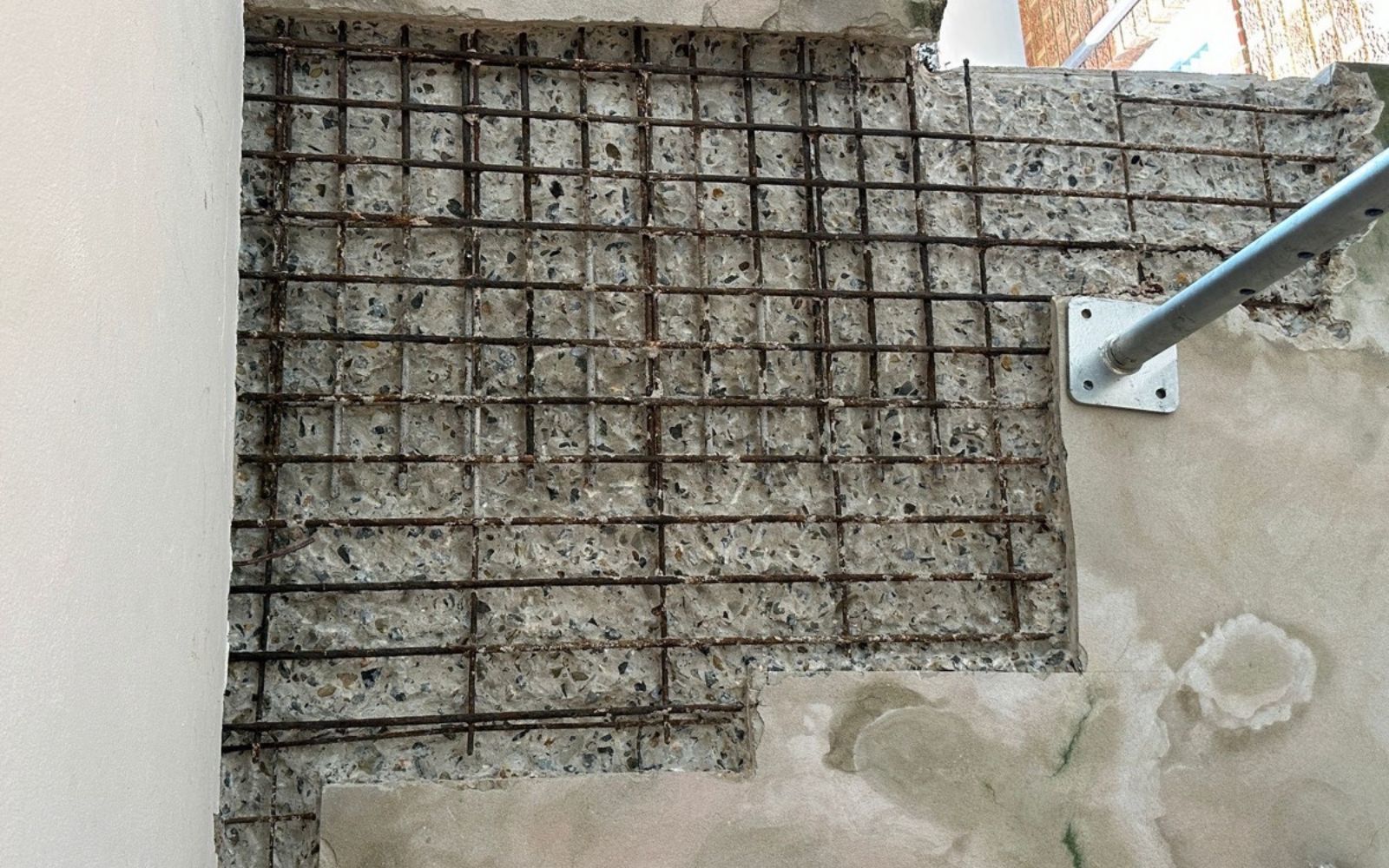
Laycock Ave — Cronulla
Stair soffit repaired with Sika MonoTop, formed and poured from above in an occupied building.
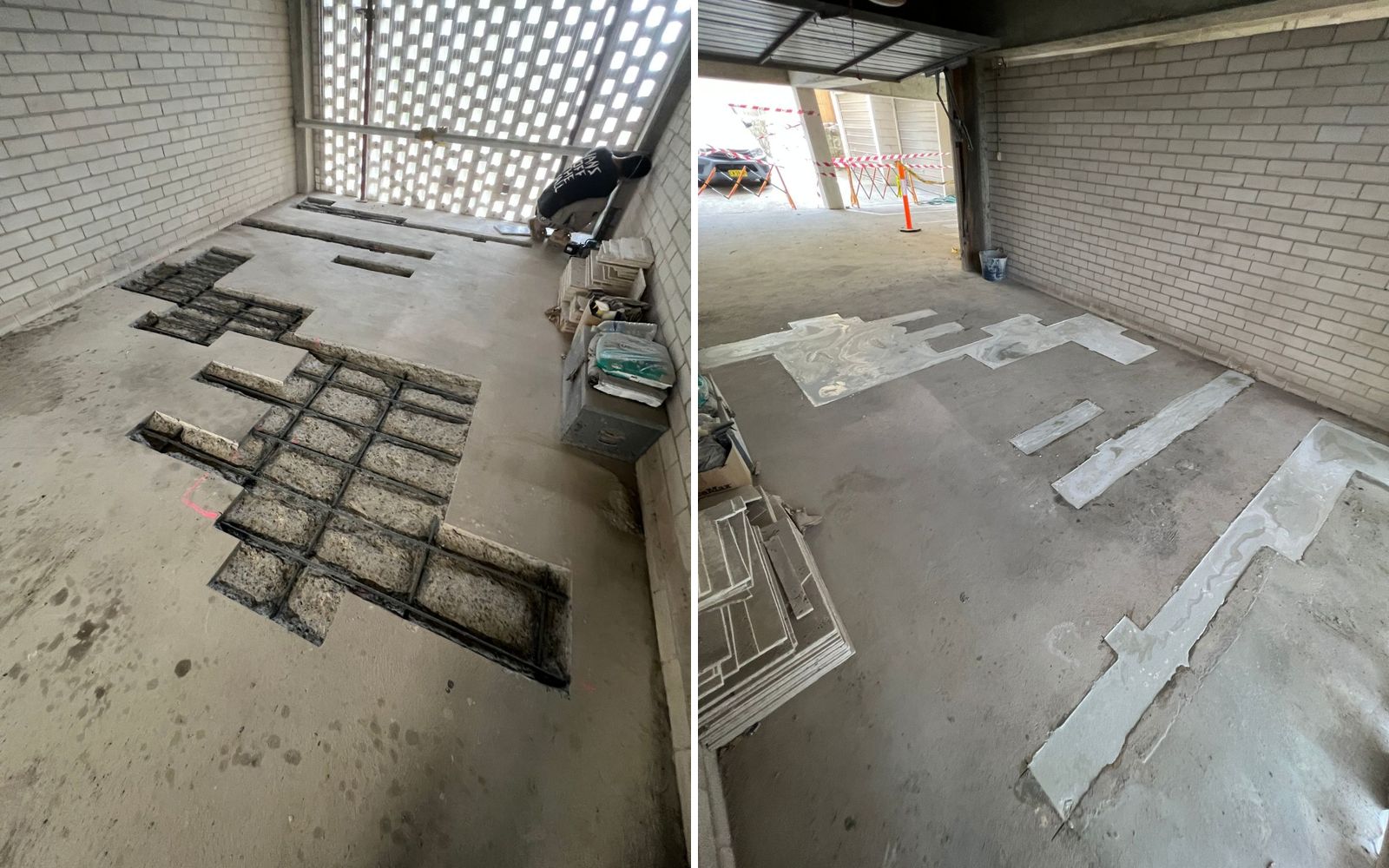
Birrell St — Tamarama
About 1,000 litres of carbonation repairs plus new crash barriers, staged so the carpark stayed open.
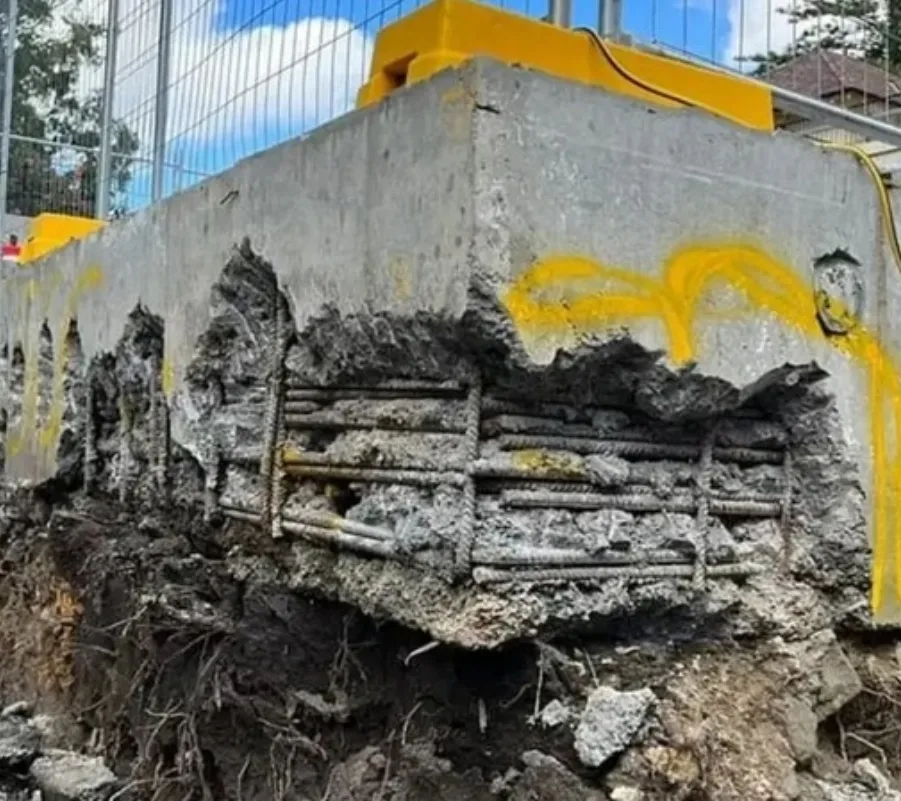
Coolong Rd — Vaucluse
Honeycombed pour and corroding reinforcement broken back, treated, rebuilt and coated.
Aussie Concrete Repair vs a concrete sub who improvises.
Two concrete subs can hold the same licence and treat the engineer’s spec completely differently once they’re on site. Here’s the gap that decides whether your close-out is clean.
What we hand back — and what to send us.
Your close-out is only as clean as the records behind it. We keep them as we work, so they’re ready when you need them. Here’s what we hand back, and what helps us price and build the scope accurately.
What we hand back
Kept as the work proceeds — not reconstructed afterwards — so your close-out pack is complete.
Dated photos — before, during and after each repair, by area, before anything is covered up.
Quantities — repaired areas, injected lengths, pours and cuts, recorded against the scope.
Hold point sign-offs — inspections recorded as each stage is released.
Product records — the systems installed, matched to the spec.
Scan records — wherever we cut or break out.
Close-out summary — a handover record of what was done, and where.
What to send us
The more of this you have, the tighter the price. Don’t have it all? The engineer’s report or a few photos are enough to start.
The engineer’s report / scope — the repair systems and methods specified.
The drawings & mark-ups — locations and quantities, so we price the scope, not a guess.
Hold / inspection points — where the engineer wants to inspect.
Access & site rules — hours, noise and dust limits, occupied areas.
Your program — start date, access windows and the trades either side of us.
What the concrete scope costs — so you can price your project.
Indicative project ranges, ex GST. The final number depends on the repair type, quantities and access — send the scope and we’ll send an itemised quote, priced to the spec, within 7 days.
A single repair type — a few patches, a run of cracks, a run of joints.
Several concrete services on one project — e.g. break-out, repair and coating.
The full concrete scope on a remedial project, staged to your program.
Every scope is priced against the spec and the quantities, with assumptions stated up front — so a variation is never a surprise you have to pass on.
Check us out before you engage us.
Most concrete call-backs come from a sub who patched instead of repaired — and can’t show what they did. We keep the records.
We'd rather you check than take our word for it.
From scope to signed-off — no mystery.
We're a fit for some projects, not all.
This is for you if…
- ✓You’re a remedial builder or specialist contractor with a concrete scope to sub out.
- ✓The work is specified by an engineer and needs hold points called and verified.
- ✓You need records for your close-out pack.
- ✓The site is live or occupied and works need staging around your program.
- ✓You want one crew across repair, form-and-pour, injection, carbon fibre, sealing, coatings, levelling and demolition.
Probably not us if…
- —You want the cheapest interpretation of the spec — that’s not how we work.
- —There’s no scope yet and you need a design — that’s the engineer’s role; we build it.
- —You need a waterproofing, façade or render trade — we only do concrete.
- —You need someone to certify structural adequacy — we build to the engineer’s design, we don’t certify it.

You’ll deal with the crew lead, not a call centre.
Concrete is all we do. We work under remedial builders and specialist contractors on Sydney sites — building the concrete scope to the engineer’s spec, calling hold points and handing back the records — so the concrete is the part of the project you don’t have to chase.
What a remedial contractor will want to know.
Will you build exactly to the engineer’s spec?+
How do you handle hold points?+
What records do I get for my close-out?+
What if site conditions differ from the scope?+
Which concrete services can you cover?+
Are you licensed?+
How do you price a concrete scope?+
Can you review buildability before tender?+
How quickly can you mobilise?+
Do you work on occupied or live sites?+
Do you warranty the work?+
A concrete crew that builds to spec.
Send the engineer’s report, the scope or a few photos. We call back within the hour.