

When concrete damage is too deep to patch: engineer-designed reo, the reo hold point, repair concrete vs micro-concrete, pumping, cure and stripping.
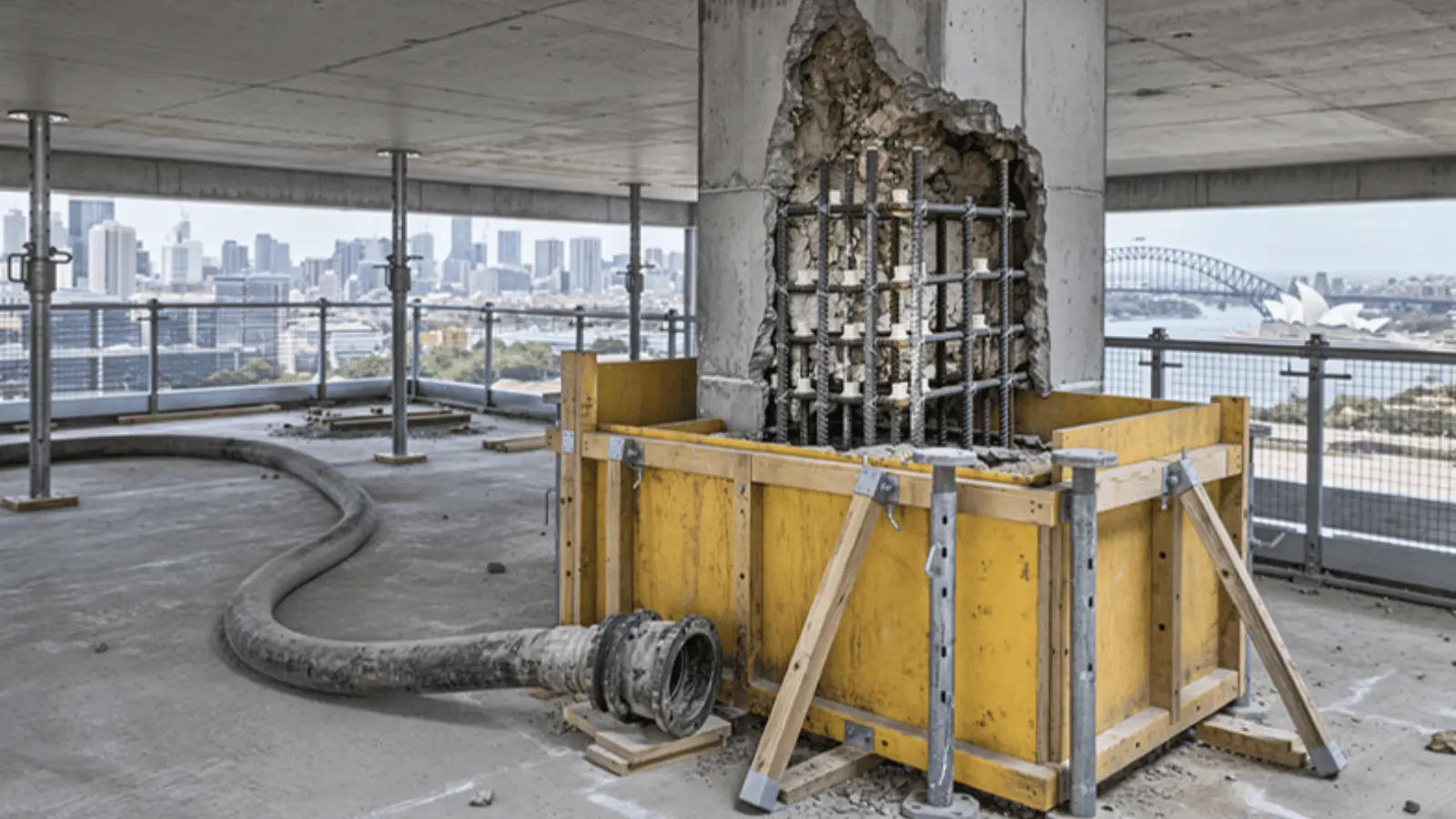
Patch when the damage is shallow, the area is small and the reinforcement is sound. Form and pour when the breakout goes deep or wide, steel has to be replaced or added, or a whole section has to be rebuilt. The engineer makes that call and designs any new reinforcement. The contractor forms, places, cures and records it.
Hand-applied repair mortar works well on shallow, contained repairs: spalls on soffits, edges and faces where the steel is cleaned and treated and the section is rebuilt in layers. As repairs get deeper, larger or more structural, building them up by hand gets slower, harder to compact and riskier for voids. That's when the specification usually moves to formwork and a poured repair.
Common triggers we see on Sydney projects:
Product data sheets set the thickness limits for each repair material, and the engineer's specification sets which method applies where. If your scope says "patch" but the breakout keeps going deeper, stop and get direction rather than building it up layer after layer.
New reinforcement in a repair is structural work, so it's designed by the engineer. The design normally covers bar sizes and spacing, laps with existing steel, any drilled and epoxied starter bars or dowels into sound concrete, cover, and how the repair ties back into the existing element. Where existing steel has corroded badly, the engineer decides whether to splice in new bar, add supplementary bars or rely on the remaining section.
We fix the reo to those details, from the engineer's drawings and sketches. If something on site doesn't match the drawing, such as bars in a different place or more section loss than expected, we stop and ask. We don't design or certify structural work, and we won't improvise a reinforcement detail to keep the program moving.
On almost every repair pour, the reo inspection before the pour is a hold point. Once the concrete is placed, nobody can check the steel again. The engineer, or their representative, typically checks:
We photograph and record the reo before calling for inspection, so the engineer arrives to something that's ready. Booking that inspection early is often the single biggest program saving on a repair pour.
For poured repairs the engineer will specify the material, usually one of two families:
A conventional concrete mix to a specified strength, delivered by truck. It suits larger volumes where a full load makes sense and access allows. Aggregate size has to suit the bar spacing and cover, and the mix needs to be placed and compacted properly around the steel.
Pre-bagged, shrinkage-compensated, highly flowable repair materials designed for poured and pumped repairs into formwork. They flow around congested steel and into tight sections with little or no vibration and are mixed on site in controlled batches. They suit smaller, more intricate pours, such as column jackets, beam ends and slab edges, where a truck of ready-mix would be wasteful or the section is too tight.
Either way, we record the batch details, whether that's the delivery dockets or the product batch numbers, alongside the pour location in the project records.
How the material gets into the form is a practical decision driven by access, volume and the element:
Overhead repairs are the tricky ones. Forms for soffit and beam repairs need a pour point and air bleed so the repair fills completely, and that's planned when the formwork is designed, not on the day.
A repair pour is only as good as its curing. The specification sets the curing method and duration, such as keeping forms in place, wet curing or a curing compound, and the engineer sets when forms can be stripped and when the element can take load or have props removed. Cold weather slows strength gain, and hot, windy conditions increase the risk of shrinkage cracking, so cure plans change with the season.
We record cure start and finish and stripping dates, and hand those records back with the reo and batch records. Any protective coating follows only once the repair has cured as specified. See protective coatings.
Sometimes, within the product's thickness limits and if the engineer agrees. Past that point, layer-on-layer patching risks voids around the steel and poor bond, which is exactly where corrosion restarts. If the spec calls for a pour, we pour.
Access and propping, the size and number of sections, how much new reo and doweling the design requires, the material (ready-mix or bagged micro-concrete), pumping, the hold point regime and working hours. Send the engineer's drawings and we'll price it to the design.
That's the engineer's call, based on the specified material and cure. We give you the cure records so they can release it.
Reo photos and inspection sign-off, batch records, cure and stripping dates, and the location in the repair register, ready for your close-out file.
Send the engineer's details, drawings and photos to quotes@aussieconcreterepair.com.au or call 0410 515 509. We call back within the hour and send an itemised quote within 7 days. NSW licence 360636C, ACRA member. More on the service: form, reo and pour repairs. For shallower spalling, see concrete cancer and spalling repair.
Send photos, the engineer's spec or drawings, or just the symptoms — whatever you've got. The crew reads it and calls you back. No call centre, no obligation.