

Concrete floor levelling: grind the highs, pour the lows. How Sydney builders get an out-of-tolerance slab ready for tiles, vinyl or timber.
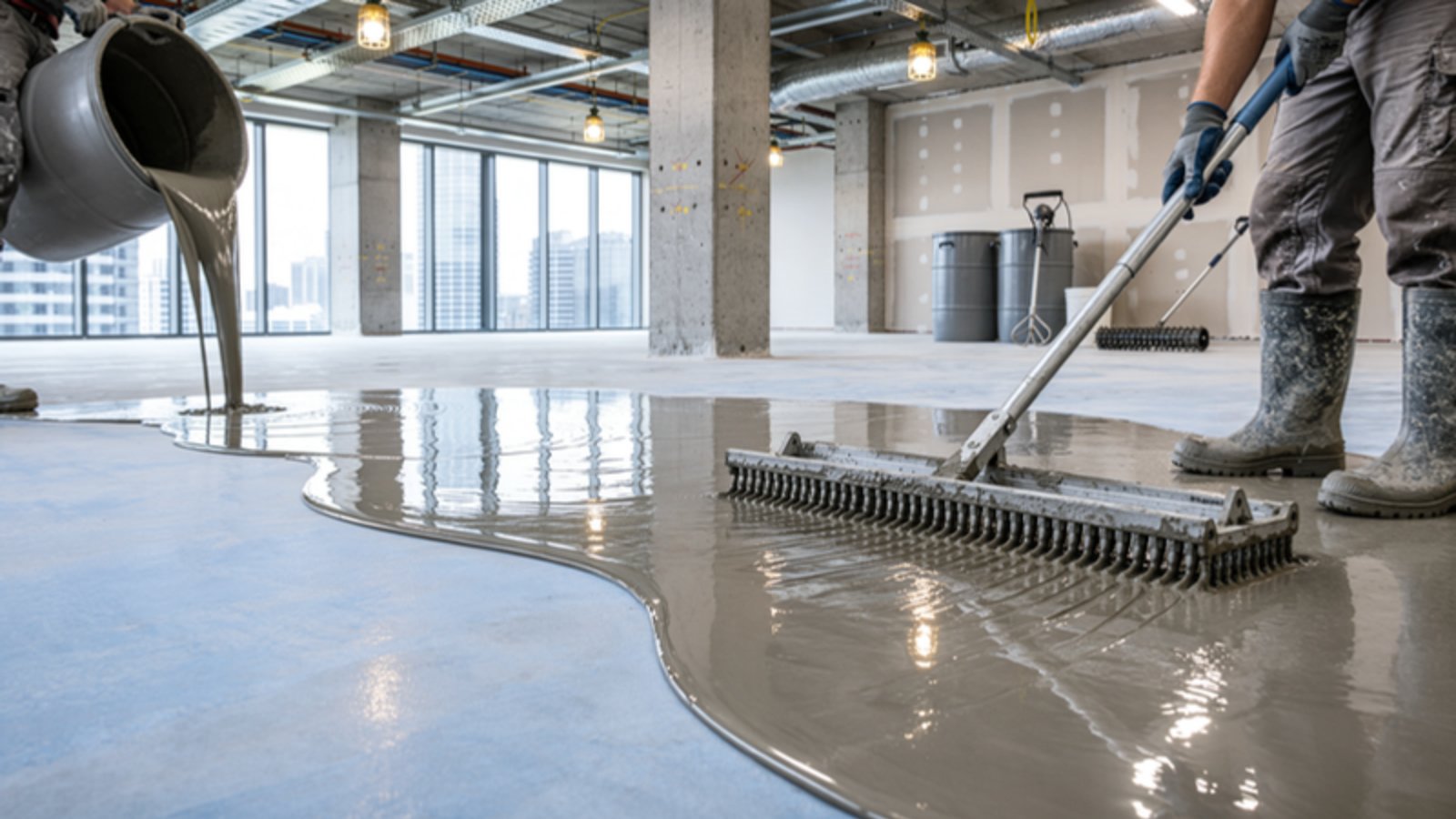
Quick answer: Grind the high spots, pour the low spots, and most slabs need both. Concrete floor levelling starts with a level survey against the tolerance your floor finish calls for. Humps, ridges and curled joint lips are ground down; dips are filled with a primed, cementitious self-levelling or smoothing compound. The floor is checked against tolerance before the flooring trade starts.
Tiles, vinyl, timber and resilient sheet all telegraph what's underneath them. Lay them over dips, ridges or a lip at a control joint and you get lipping, rocking boards, visible bumps under vinyl and water sitting where it shouldn't. That shows up at handover as a flooring defect, but the cause is the slab.
By the time it's found, the flooring trade is booked and the program is tight. Sorting the floor before the finish goes down is the cheaper fix every time. That is the work our concrete floor levelling crew in Sydney does: survey, grind, prepare, prime, pour and check, so the floor is ready for the next trade.
The level survey decides it. Grinding removes material, so it only fixes high spots. A compound adds material, so it only fixes low spots. Pouring compound over a high spot just buries it and thickens the pour everywhere else.
For the detail on each method, see slab grinding and joint lip removal and self-levelling and smoothing compounds.
The one your floor finish or the specification calls for. Different finishes have different flatness requirements, and the flooring manufacturer's installation instructions or the project spec set the number. Send it to us with the scope. We survey against that tolerance, scope the grinding and pour to it, and check the finished floor against it before we hand back.
If the spec is silent, ask the flooring trade what they need before anyone prices the levelling. Getting that number up front stops the floor being levelled twice.
Most failures come back to bond and sequence, not the product:
That's usually the flooring trade's or the specification's call, because the floor finish sets the moisture requirement. Tell us what's required and we'll fit it into the sequence so the testing, levelling and flooring run in the right order.
Floor levelling is priced per m², confirmed after the level survey. The quote moves with:
For an early budget, our concrete repair cost estimator gives a starting point. For a fixed number, send the area, the finish going down and the tolerance.
If the slab also has spalling or exposed reo, read our guide on concrete cancer on a live site before you plan the floor.
Yes. Curled joint edges and lips can be ground on their own where the rest of the floor is in tolerance.
It depends on the compound, depth and conditions. We give you the hand-back time with the quote.
Yes. Grinding, prep and pours are staged around your program and the other trades on site.
Yes. Spalled or cracked concrete is repaired first, then prepared, primed and levelled in the same program.
The area, the floor finish going down, the tolerance it needs and any drawings or photos. A level survey confirms the scope.
Send the area, the finish and the tolerance to quotes@aussieconcreterepair.com.au or call 0410 515 509. We respond within the hour, send an itemised quote within 7 days, and typically start about 2 weeks after award. Work is backed by a 10-year written warranty. NSW licence 360636C · ABN 53 627 550 323 · ACRA member.
Send photos, the engineer's spec or drawings, or just the symptoms — whatever you've got. The crew reads it and calls you back. No call centre, no obligation.