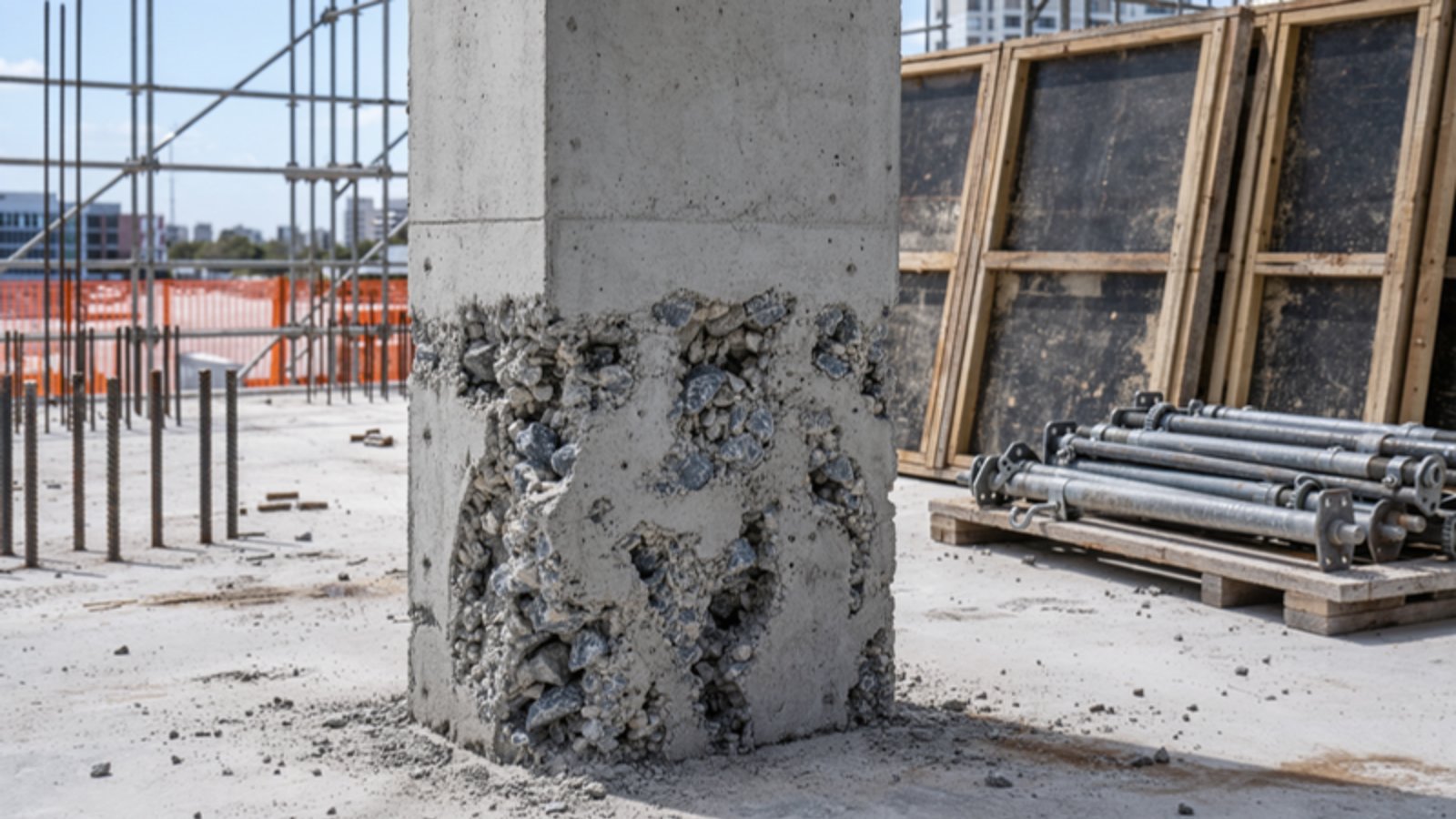
What causes honeycombing
Honeycombing happens when the paste doesn't fill around the aggregate — poor vibration, congested reo, grout loss through formwork joints, or a mix that was too stiff. The result is voids, bony faces and, at worst, reduced cover over the steel. It shows up when the forms come off, usually on columns, walls, beams and slab edges.
Why it matters on your project
It's an obvious defect on a walkthrough, and where it reduces cover it becomes a durability problem — the steel is less protected, which is how carbonation and spalling start years later. Fixing it properly before handover is cheaper than arguing about it at defects.
How we make it good
- Assess with you and the engineer — surface blemish, or a void that needs structural reinstatement.
- Cut back loose and poorly compacted material to sound concrete.
- Reinstate with the specified repair mortar — formed, or hand-placed for smaller areas — to line and level.
- Finish to match the surrounding surface as closely as the spec requires.
- Record each location with photos for your close-out.
Questions builders ask
Can you work to the defects list?
Yes. Send us the list or marked-up photos and we'll price and work through it location by location.
Is every void structural?
No — many are cosmetic. Deep voids, exposed reo or voids at critical sections go to the engineer for direction, and we repair to what they specify.
Related repairs
Part of concrete cancer and spalling repair. See also spalling repair, carbonation repair and chloride attack repair. Cracks go to crack injection.
Send us the defects list or photos — we call back within the hour.